How AI is transforming Retail Merchandising
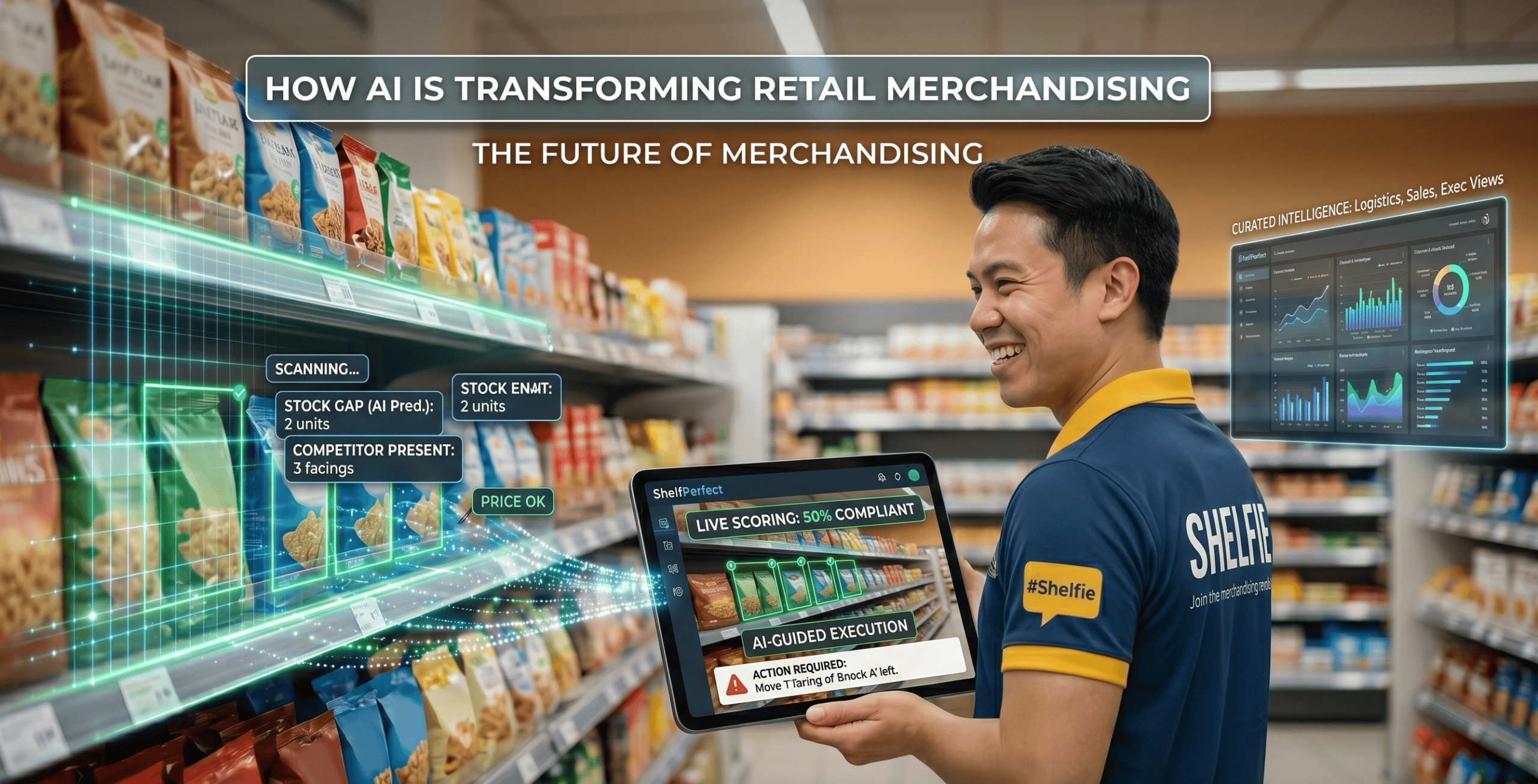
Retail merchandising has always been about getting the right product in the right place at the right time. AI doesn’t change that goal — it makes it possible to achieve it with a precision and consistency that no human team alone ever could.
For decades, the merchandising visit followed the same basic loop: a rep visits a store, fixes what they can, fills out a form, and sends it back to head office. By the time anyone reviews the data, the moment has passed. Sales are lost. Standards drift. Insights arrive too late to act on.
ShelfPerfect was built to break that loop. What follows is a look at exactly how AI changes each part of the merchandising process — and what that means for retailers, suppliers, and the people doing the work on the ground.
1. Live scoring and instant feedback
The biggest enemy of great merchandising isn’t a poorly trained rep. It’s the delay between doing the work and finding out if it was done right. Traditional audits score visits hours or days after the fact, which means mistakes get locked in and sales are lost in the window between the visit and the feedback.
ShelfPerfect’s AI scores every task as it’s completed. A merchandiser completes a task, and within seconds the system evaluates it against the perfect shelf reference — checking facings, position, price labels, POS material, and stock availability — and returns a score with specific, actionable feedback before they move to the next task.
⚡ The shift
- Traditional model: visit happens → data submitted → manager reviews → feedback given → rep adjusts → days have passed.
- ShelfPerfect model: visit happens → AI scores → rep corrects → perfect shelf, same visit.
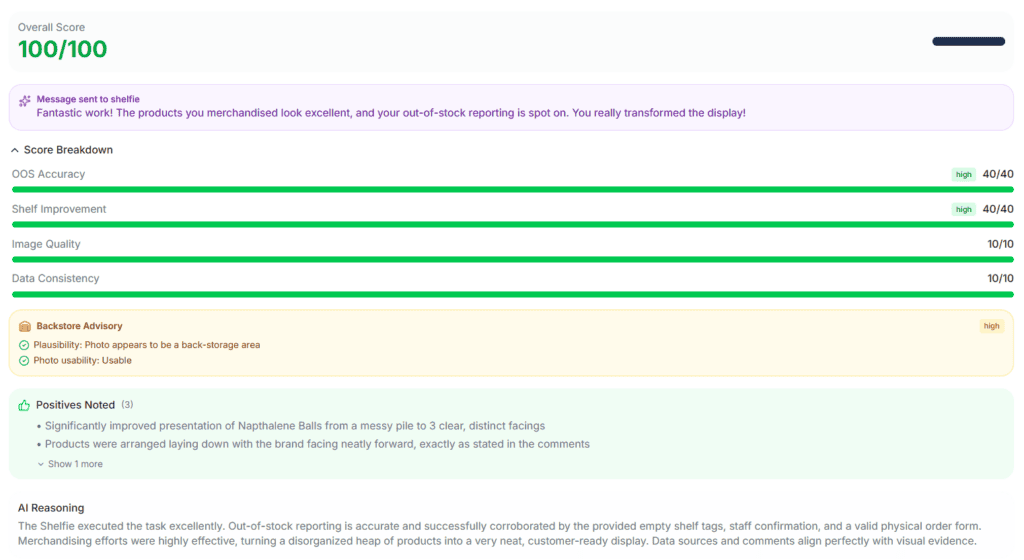
This isn’t just faster. It’s a fundamentally different kind of merchandising. When the feedback loop closes in seconds rather than days, reps can fix issues before they leave the store. Managers no longer spend time reviewing reports from visits they can’t change — they spend time on what’s happening now. And every corrected shelf means sales that would otherwise have been lost are recovered in real time.
2. AI coach in your pocket on every visit
The best merchandisers carry an enormous amount of knowledge in their heads: which stores have unusual fixture layouts, which categories have new ranging updates, which locations are easy to miss on a busy visit. That knowledge takes years to accumulate — and it lives entirely in individual people, which makes it fragile.
ShelfPerfect acts as an intelligent guide alongside every merchandiser. When a rep starts a visit, the app surfaces everything relevant for that specific store: the live planogram, any ranging changes since the last visit, location notes for hard-to-find fixtures, and step-by-step task sequences that ensure nothing is skipped.
“It’s like having a senior merchandiser standing next to every rep on every visit — one who knows every store, every planogram, and every change that happened this week.”
When the AI detects a potential miss — a location that hasn’t been checked, a task that seems out of sequence — it prompts the rep proactively. Not with criticism, but with a simple nudge. This kind of ambient guidance dramatically reduces errors without making reps feel micromanaged.
The result is a workforce that performs more consistently regardless of experience level. A new rep working their third store ever can perform at the standard of someone who has visited that location fifty times. That consistency protects the brand, reduces the coaching burden on managers, and makes growth and coverage expansion far less risky.
🧭 What this means in practice
Onboarding time for new merchandisers is cut significantly. Coverage can expand into new territories without a proportional dip in quality. Experienced reps spend less mental energy remembering and more time executing and perfecting.
3. Quality at any scale: from 10 stores to 10,000
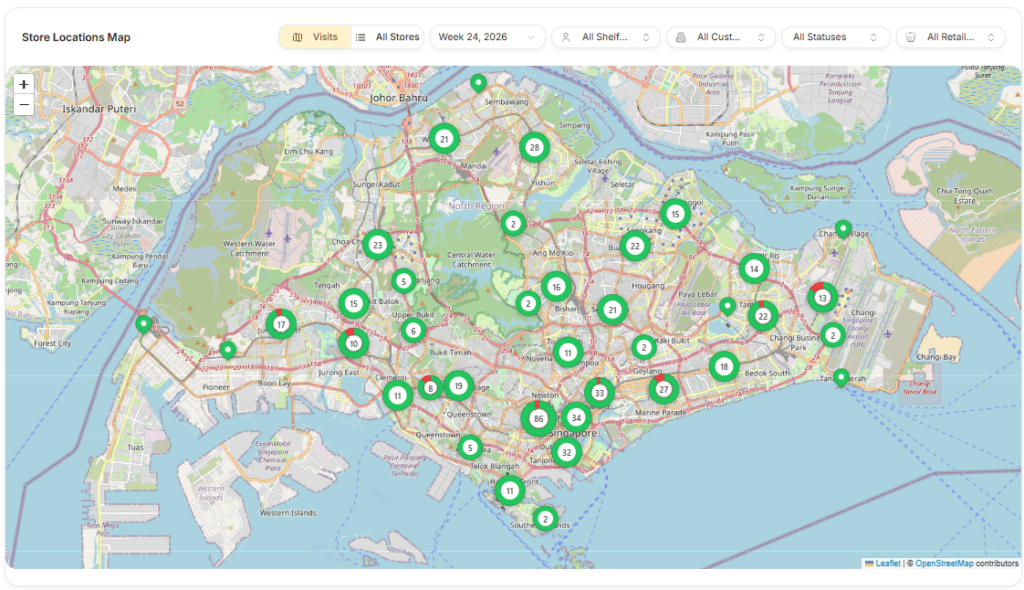
The traditional trade-off in merchandising has always been scale versus quality. You can cover more stores with more reps, but the more you scale, the harder it becomes to maintain consistent standards. Managers can only review so many visit reports. Training has diminishing returns across a large, dispersed team. Standards drift.
AI eliminates that trade-off. Because scoring and quality control happen automatically — at the point of execution, for every rep, on every visit — the quality standard doesn’t degrade as coverage expands. A team of 10 merchandisers and a team of 1,000 operate at the same level of quality assurance.
This unlocks a genuinely new operating model. Retailers and suppliers can now think about coverage as a pure commercial question — what level of visit frequency generates the best return in this channel? — rather than a quality management question. The AI maintains the quality floor. The commercial team sets the ambition.
📡 The coverage advantage
Every store visit — regardless of which rep completes it — is reviewed, scored, and validated before it’s logged as complete. Coverage expansion becomes a commercial decision, not a quality risk.
For businesses currently managing merchandising teams across different geographies — where direct management control is limited — this is transformative. ShelfPerfect’s AI is the consistent standard across every rep, every area, and every geography.
4. Every visit builds a database, and a competitive advantage
A merchandising visit has always generated value through what gets fixed: a restocked shelf, a corrected planogram, a replaced price label. But in the ShelfPerfect model, every visit also generates a second kind of value that has historically been left on the table: structured data about what was actually found.
When an AI scores a shelf, it doesn’t just check compliance — it records the full state of the shelf at that moment. Which products were out of stock. Which competitor products were present. What the actual share of shelf was versus what was planned. Whether display space was being used as agreed. All of this is captured, structured, and stored against a timeline and location.
Individually, each visit captures a snapshot. Collectively, across hundreds of stores and dozens of visits per store, the data builds into something that didn’t exist before: a continuous, structured, time-stamped record of what the shelf reality looks like across your entire estate.
📊 A new kind of asset
Retailers who treat the merchandising visit as a data collection exercise as much as a fixing exercise build an insight advantage that compounds over time. The more visits, the richer the picture — and the sharper the strategy.
This data becomes genuinely novel intelligence. Not sales-out data from tills, which tells you what sold. Not delivery data from logistics, which tells you what arrived. Shelf data tells you what was actually available and visible at the moment of purchase — the gap between those three sources is where the real insight lives.
5. Real time reporting and insights
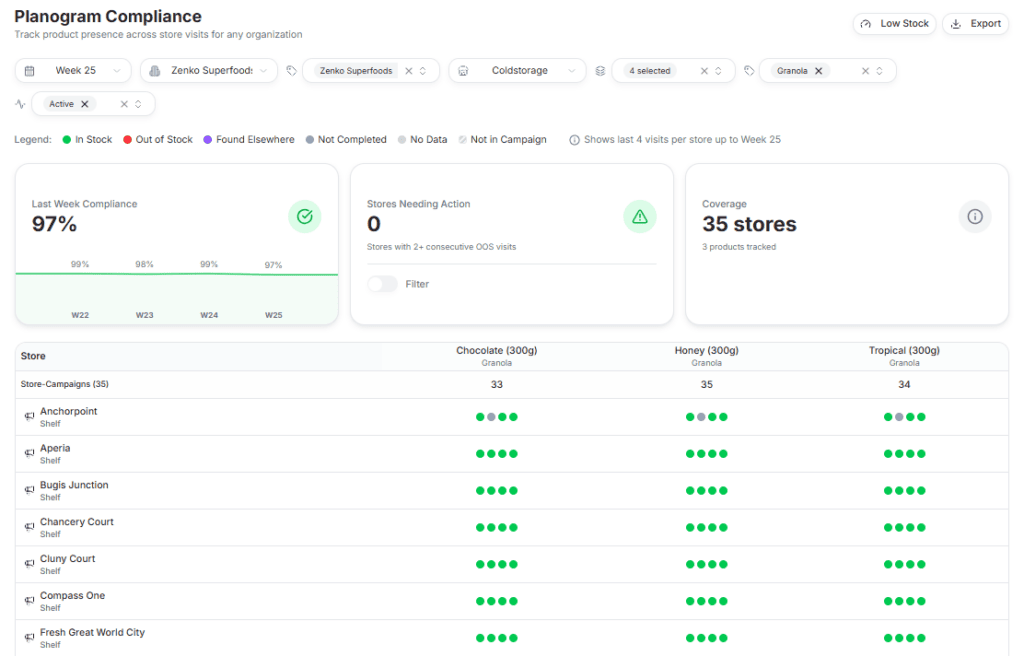
Data is only valuable if the right people see the right parts of it at the right moment. One of the persistent failures of traditional merchandising reporting is that everyone gets the same report — which means the logistics manager is wading through store-compliance scores they can’t act on, while the sales manager is buried in delivery exceptions that aren’t their problem.
ShelfPerfect curates insights automatically by role and need, so every team in the organisation sees a live view of exactly what’s relevant to them.
| Logistics & Operations Order and delivery intelligence Live visibility into stock gaps identified during visits. Which stores are running low? Where are deliveries not landing as planned? Merchandising data feeds directly into replenishment triggers. ► Live stock gap alerts | Sales Management Store-level performance view Which stores are consistently underperforming on compliance? Which reps need support? What execution issues are dragging down results in a territory? ► Territory compliance scores |
| Executive Team The shelf, from 30,000 feet A live executive dashboard showing brand presence, share of shelf, compliance rate, and coverage across the entire estate — updated in real time as visits are completed. Strategy and planning informed by what’s actually happening on shelf today, not what was reported last month. ► Real-time estate dashboard |
This layered insight model means that a single merchandising visit generates value across the entire organisation simultaneously — fixing the shelf for the consumer, feeding replenishment for logistics, informing coaching for the sales manager, and updating the strategic view for the exec team. All from the same visit. All in real time.
The merchandising visit has always been one of the most undervalued assets in retail. Not because the work isn’t important — but because most of the value it creates has historically gone uncaptured. AI changes that. Every visit becomes an execution event, a quality check, a data collection exercise, and a strategic insight — all at once, all in real time.
That’s not an incremental improvement on traditional merchandising. It’s a different model entirely.
Ready to see it in action?
Book a demo and we’ll show you ShelfPerfect running live — scoring shelves, guiding reps, and building insights in real time.
► Book a demo at shelfperfect.com/demo